
Neel Networks
When growth has slowed

Digital & Business Transformation for Business Growth .

Every growing company reaches a point where the way it works begins to hold it back. Orders live in inboxes, the same information is entered in several places, and serving more customers means employing more people. Digital and business transformation helps improve those processes, systems and technology carefully, one meaningful step at a time, without asking the business to stand still.

Does this sound familiar?

The signs tend to be familiar.

  • Growth now calls for more colleagues rather than better systems.
  • The same information is entered in several places, and the versions no longer agree.
  • Preparing a report means somebody spending a day with spreadsheets.
  • Important processes live in one person’s memory, and everybody knows whose.
  • A system from some years ago cannot easily be changed, so the business works around it.

None of this reflects a failure of technology. It is simply a business that has grown faster than the arrangements it was set up with.

How we go about it

A practical transformation programme, in stages — never all at once.

Long rewrites disappoint because nothing improves until the very end. We prefer to change one business process at a time, with the business running throughout.

01

Map

How work truly flows today, including the workarounds colleagues have invented to get through the day.

02

Prove

One process improved first, chosen because it is painful and self-contained. Its success earns confidence for the rest.

03

Extend

The next flows in sequence, each one working properly before the following begins.

04

Hand over

Documentation, training and ownership within your own team, so that further improvement need not depend upon us.

What you get

Measurable improvements your team will notice each quarter.

  • A clear picture of how the work runs today, agreed with the people who do it.
  • A staged digital transformation plan, with the first stage small enough to prove quickly.
  • Fewer places where the same information must be entered twice.
  • Reporting that comes from the system rather than from somebody’s evening.
  • Your team trained and holding the knowledge, rather than ourselves.

Well suited to you if

  • There is a genuine operational difficulty, not simply an ageing website.
  • Leadership is willing to adjust process as well as software.
  • We may spend a little time with the colleagues who do the work each day.

Perhaps not, if

  • You would like the present processes rebuilt exactly as they are, only faster.
  • Nobody within the business can take ownership once the change is delivered.
In practice

One process at a time.

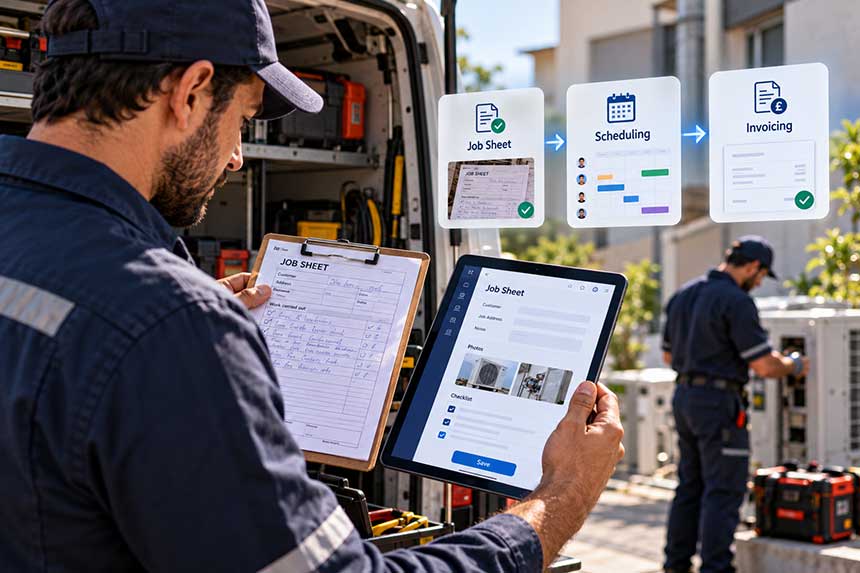
A field services business ran everything through paper job sheets, typed up each evening. A complete rewrite had been quoted twice and never begun, because the disruption seemed too great.

What changed: We changed the job sheet first and left everything else untouched. Once that was working, scheduling followed, and then invoicing. Each stage was in use within weeks.

Read the full case study
Operations platform

One platform to replace disconnected business systems

Departments each ran their own tools and spreadsheets, so nobody could see a job end to end.

Read the full case study

Shared anonymously at our client's request. We never invent names or figures; where detail cannot be shared, we simply leave it out.

Questions

A few questions you may have.

The Business & Digital Health Check and a Second Opinion are free. Strategy, AI readiness and transformation work are paid engagements, quoted as a fixed piece of work once we know the scope. There is no hourly billing.

Check your business health ↗
How long does transformation take?

The first visible improvement usually arrives within weeks. The wider digital transformation programme runs across quarters by design, as each stage should be working well before the next begins.

Will our team resist the change?

Some may, and often for good reasons. That is why we begin with the process colleagues already find frustrating, and why the people doing the work help shape the change.

Must we replace everything?

Not at all. Older systems that work well are left in place. The aim is to remove duplication and manual effort, not to purchase software for its own sake.

What if we pause after the first stage?

Then you keep a genuine improvement and owe nothing further. Each stage stands on its own.

Get Started

Begin with one process, rather
than the whole company.

We would be glad to suggest which one to change first, and explain why.

Takes about
ten minutes
Prefer to talk
first?
About 10 minutes
Clear recommendations
No obligation